
Chesapeake Bay, USA
Main Contributors:
Other Contributors:
Summary
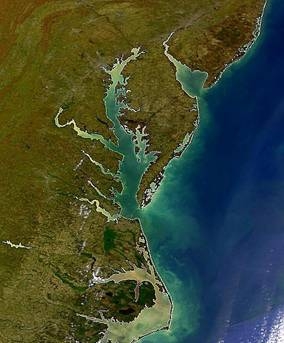
The Chesapeake Bay is an estuary into which more than 150 rivers and streams drain. Hypoxia was observed already in the 1930s. By the 1970s there was consistent anoxia in the summer months. In the 1980s the hypoxic and anoxic conditions covered most of the bay bottom with year-to-year variation. To some extent, hypoxia in the Chesapeake Bay is natural since the bay has a large catchment area, seasonally stratified water mass and isolated basins. Opinions differ on the degree to which hypoxia has worsened due to eutrophication, but it is clear that hypoxia intensified greatly between the mid-1950s and mid-1980s, which is the period when human population in the Chesapeake Bay watershed nearly doubled and the use of inorganic fertilizers nearly tripled.
Chesapeake Bay is particularly susceptible to dysfunction from eutrophication. Compared with other marine ecosystems, the bay has higher primary production than would be predicted from known nutrient inputs. The size of the bay, material residence times, and tidal and non-tidal circulation lead to a greater recycling and reuse of nutrients. Large quantities of sessile benthic biota die during summer hypoxia and anoxia. Although some species migrate, fall recolonization may fail and cause changes in communal dominance. Migration of fish may also cause fish declines as available food supply and space decline. Species changes in phytoplankton communities have been observed and timing, quality and size of the blooms have changed.
Chesapeake Bay is particularly important as a spawning and nursery ground for many species. Many species that play fundamental ecosystem roles in Chesapeake Bay are in decline, as are several species of key economic importance to the region. Chesapeake Bay is used for commercial shipping, generation of electricity, waste disposal, commercial harvesting of wildlife, recreation and research. In 1987 a commitment was made to reduce controllable sources of nitrogen and phosphorus to combat eutrophication. Nutrient inputs have decreased.
Type of regime shift
Ecosystem type
- Marine & coastal
Land uses
- Fisheries
Spatial scale of the case study
- Sub-continental/regional (e.g. southern Africa, Amazon basin)
Continent or Ocean
- North America
Region
- North America
Countries
- United States
Locate with Google Map
Key References
-
Officer C, Biggs R, Taft J, Cronin E, Tyler M, Boynton W. 1984. Chesapeake Bay anoxia. Origin, development and significance. Science 223, 22-27.
-
Zimmerman A, Canual E. 2000. A geochemical record of eutrophication and anoxia in Chesapeake Bay sediments: anthropogenic influence on organic matter composition. Marine Chemistry 69, 117-137.
