Message

Case Studies (332)
Wadden Sea
Main Contributors:
Other Contributors:

Summary
The Wadden Sea is a large, relatively flat coastal environment. Strong increases in nutrient concentrations and primary production took place in the Wadden Sea in the late 1970s and 1980s. Indications of hypoxia in Wadden Sea were first observed in 1988. In 1996, large anoxic areas occurred in the East Frisian basin. It is debated whether hypoxia in the Wadden Sea is natural or not, but the signs of eutrophication are clear.
Type of regime shift
Ecosystem type
- Marine & coastal
Land uses
- Fisheries
Spatial scale of the case study
- Sub-continental/regional (e.g. southern Africa, Amazon basin)
Continent or Ocean
- Europe
Region
- Northwest continental Europe
Countries
- Netherlands
- Germany
Locate with Google Map
Key References
-
Colijn C, van Beusekorn J. 2005. Effects of eutrophication of phytoplankton community and growth in the Wadden Sea. In: Wilson, J (Ed.). 2005. THe intertidal Ecosystem: The Value of Ireland's Shores, 58-68.
-
Hoppema J. 1991. The oxygen budget of the western Wadden Sea, The Netherlands. Estuarine, Coastal and Shelf Science 32, 483-502.
-
Kaiser J, Lutter S. 1998. Do we have the right strategeis to combat eutrophication in the Wadden Sea? - A critical review of current policies. Senckenbergiana Maritima 29, 17-24.
Citation
Mauritania Coast, Mauritania
Main Contributors:
Other Contributors:


Summary
The rapid intensification of Mauritanian agriculture may indirectly increase hypoxia through fertilizer usage. Point and non-point source pollution into Mauritanian's coastal waters should be managed to protect the benthic biodiversity.
Type of regime shift
Ecosystem type
- Marine & coastal
Land uses
- Fisheries
Spatial scale of the case study
- Sub-continental/regional (e.g. southern Africa, Amazon basin)
Continent or Ocean
- Africa
Region
- West Africa
Countries
- Mauritania
Locate with Google Map
Key References
-
Le Loeuff P, von Cosel R. 1998. Biodiversity patterns of the marine benthic fauna of the Atlantic Coast of tropical Africa in relation to hydroclimatic conditions and paleogeographic events. Acta Oecologica 19, 309-321.
-
Le Loeuff, P. 1999. The benthic macrofauna of the variable saline waters ecosystems along the Atlantic coast of tropical Africa; biodiversity variations with the current climatic conditions (rainfall) and the regional climatic history. Zoosystema 21, 557-571.
Citation
Donegal Bay, Ireland
Main Contributors:
Other Contributors:

Summary
Donegal Bay experienced mortalities of marine fauna in 2005. It has been suggested that the kills were brought about by oxygen depletion, which was caused by intense blooms of Karenia mikimotoi, the most common local dinoflagellate species causing red tides. The large scale of the blooms had never been observed before. Large quantities of dead sea urchins and lugworms were deposited on the beaches of west Ireland, and several cultured and wild fish species died. Hypoxia may have been caused by dinoflagellate respiration or decompostion and it may have acted as a cause to mortalities or as a significant stress factor indirectly leading to the death of fauna.
Type of regime shift
Ecosystem type
- Marine & coastal
Land uses
- Fisheries
- Tourism
Spatial scale of the case study
- Local/landscape (e.g. lake, catchment, community)
Continent or Ocean
- Europe
Region
- Northwest Ireland
Countries
- Ireland
Locate with Google Map
Key References
-
O'Boyle S, Silke J. 2010. A review of phytoplankton ecology in estuarine and coastal waters around Ireland. Journal of Plankton Research 32, 99-118.
-
Silke J, O’Beirn F, Cronin M. 2005. Karenia mikimotoi: An exceptional dinoflagellate bloom in western Irish waters, summer 2005. Marine Environment and Health Series 21.
Citation
Schönberger Strand, Germany
Main Contributors:
Other Contributors:
Summary
Hypoxia in Schönberger Strand is caused by both natural and anthropogenic causes. Fish kills and other symptons caused by oxygen depletion were reported already in the late 1800s and early 1900s.
Type of regime shift
Ecosystem type
- Marine & coastal
Land uses
- Fisheries
- Tourism
Spatial scale of the case study
- Local/landscape (e.g. lake, catchment, community)
Continent or Ocean
- Europe
Region
- Germany's Baltic Sea coastline
Countries
- Germany
Locate with Google Map
Key References
-
Gerlach S (Ed). 1984. Oxygen depletion 1980 - 1983 in coastal waters of the Federal Republic of Germany. First report of the working group "Eutrophication of the North Sea and the Baltic". Institut fur Meereskunde.
Citation
Hohwacht Bay, Germany
Main Contributors:
Other Contributors:

Summary
Type of regime shift
Ecosystem type
- Marine & coastal
Land uses
- Fisheries
Spatial scale of the case study
- Local/landscape (e.g. lake, catchment, community)
Continent or Ocean
- Europe
Region
- Germany's Baltic Sea coastline
Countries
- Germany
Locate with Google Map
Key References
-
Gerlach S (Ed.). 1984. Oxygen Depletion 1980-1983 in Coastal Waters of the Federal Republic of Germany. First Report of the Working Group "Eutrophication of the North Sea and the Baltic". Institut för Meereskunde nr 130.
Citation
Bay of Vilaine, France
Main Contributors:
Other Contributors:

Summary
The Bay of Vilaine hypoxia is periodic and mainly caused by phytoplanktonic biomass degradation.
Type of regime shift
Ecosystem type
- Marine & coastal
Land uses
- Fisheries
Spatial scale of the case study
- Local/landscape (e.g. lake, catchment, community)
Continent or Ocean
- Europe
Region
- North-west France
Countries
- France
Locate with Google Map
Key References
-
Chapelle A, Lazure P, Ménesguen A. 1994. Modelling Eutrophication Events in a Coastal Ecosystem. Sensitivity Analysis. Estuarine, Coastal and Shelf Science 39, 519-548.
-
Le Bris H, Glemarec M. 1995. Macrozoobenthic communities of an oxygen under-saturated coastal ecosystem: The Bay of Vilaine (Southern Brittany). Oceanologica acta 18,573-581.
Citation
Bude Bay, United Kingdom
Main Contributors:
Other Contributors:

Summary
Hypoxia may have affected the massive kill of a dog-whelk (Nucella lapillus), which occurred in the Bude Bay in 1995.
Type of regime shift
Ecosystem type
- Marine & coastal
Land uses
- Tourism
Spatial scale of the case study
- Local/landscape (e.g. lake, catchment, community)
Continent or Ocean
- Europe
Region
- South-west England
Countries
- United Kingdom
Locate with Google Map
Key References
-
Gibbs P, Green J, Pascoe P. 1999. A massive summer-kill of the dog-whelk, Nucella lapillus, on the north Cornwall coast in 1995: freak or forerunner? Journal of the Marine Biological Association of the United Kingdom 79, 103-109.
Citation
Chesapeake Bay, USA
Main Contributors:
Other Contributors:
Summary
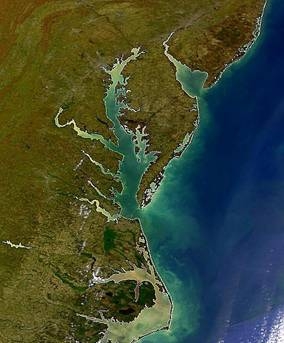
The Chesapeake Bay is an estuary into which more than 150 rivers and streams drain. Hypoxia was observed already in the 1930s. By the 1970s there was consistent anoxia in the summer months. In the 1980s the hypoxic and anoxic conditions covered most of the bay bottom with year-to-year variation. To some extent, hypoxia in the Chesapeake Bay is natural since the bay has a large catchment area, seasonally stratified water mass and isolated basins. Opinions differ on the degree to which hypoxia has worsened due to eutrophication, but it is clear that hypoxia intensified greatly between the mid-1950s and mid-1980s, which is the period when human population in the Chesapeake Bay watershed nearly doubled and the use of inorganic fertilizers nearly tripled.
Chesapeake Bay is particularly susceptible to dysfunction from eutrophication. Compared with other marine ecosystems, the bay has higher primary production than would be predicted from known nutrient inputs. The size of the bay, material residence times, and tidal and non-tidal circulation lead to a greater recycling and reuse of nutrients. Large quantities of sessile benthic biota die during summer hypoxia and anoxia. Although some species migrate, fall recolonization may fail and cause changes in communal dominance. Migration of fish may also cause fish declines as available food supply and space decline. Species changes in phytoplankton communities have been observed and timing, quality and size of the blooms have changed.
Chesapeake Bay is particularly important as a spawning and nursery ground for many species. Many species that play fundamental ecosystem roles in Chesapeake Bay are in decline, as are several species of key economic importance to the region. Chesapeake Bay is used for commercial shipping, generation of electricity, waste disposal, commercial harvesting of wildlife, recreation and research. In 1987 a commitment was made to reduce controllable sources of nitrogen and phosphorus to combat eutrophication. Nutrient inputs have decreased.
Type of regime shift
Ecosystem type
- Marine & coastal
Land uses
- Fisheries
Spatial scale of the case study
- Sub-continental/regional (e.g. southern Africa, Amazon basin)
Continent or Ocean
- North America
Region
- North America
Countries
- United States
Locate with Google Map
Key References
-
Officer C, Biggs R, Taft J, Cronin E, Tyler M, Boynton W. 1984. Chesapeake Bay anoxia. Origin, development and significance. Science 223, 22-27.
-
Zimmerman A, Canual E. 2000. A geochemical record of eutrophication and anoxia in Chesapeake Bay sediments: anthropogenic influence on organic matter composition. Marine Chemistry 69, 117-137.
Citation
East China Sea
Main Contributors:
Other Contributors:

Summary
The East China Sea has faced a huge stress from population growth in the Changjiang river (Yangtze River) drainage basin and the areas along the coasts. Hypoxia was first documented in the early 1980s. In the past two decades, the anthropogenic nutrient load from the Changjiang River has increased over 10-fold and continuous growth is expected in the future. The formation and maintenance of the hypoxia is due to anthropogenic nutrient load through the river and strong stratification. The major source of nutrients is the use of fertilizers in agriculture. It has been suggested that there have been episodic hypoxia for the past 50 years but not every year, and that all events with large size of affected area occurred after the late 1990s.
The East China Sea hypoxia is episodic and sensitive to weather conditions. The Changjiang River is dominated by the East Asia Monsoon causing high flows with large sediment loads (decomposition consumes large quantities of dissolved oxygen) to the sea during summers. Reoccurring typhoons can mix the water and decrease the hypoxic volume. The cold air southward intrusion in the summer can change the wind direction and break the hypoxia. Bottom topography of the East China Sea and inflow of Taiwan Warm Current saline water may also be additional drivers for the hypoxic areas.
East China Sea is one of the world's major fishing grounds.
Type of regime shift
Ecosystem type
- Marine & coastal
Land uses
- Fisheries
Spatial scale of the case study
- Sub-continental/regional (e.g. southern Africa, Amazon basin)
Continent or Ocean
- Asia|-|Pacific Ocean
Region
- East Asia
Countries
- China, People's Republic of
- Japan
Locate with Google Map
Key References
-
Chung-Chi C, Gwo-Ching G, Fuh-Kwo S. 2007. Hypoxia in the East China Sea: One of the largest coastal low-oxygen areas in the world. Marine Environmental Research 64, 399-408.
-
Li D, Daler D. 2004. Ocean pollution from land-based sources: East China Sea, China. AMBIO: A Journal of the Human Environment 33, 107-113.
-
Wang B. 2009. Hydromorphological mechanisms leading to hypoxia off the Changjiang estuary. Marine Environmental Research 67, 53-58.
-
Wei H, He Y, Li Q, Liu Z, Wang H. 2007. Summer hypoxia adjacent to the Changjian estuary. Journal of Marine Systems 67, 292-303.
Citation
Guanabara Bay, Brazil
Main Contributors:
Other Contributors:

Summary
Guanabara Bay is a semi-enclosed eutrophic, tropical estuarine system surrounded by large urban areas (a.o. Rio de Janeiro) and over 12 million people living in its immediate surroundings. Water exchange is mainly tidally driven through a deep channel. Nutrient inputs to the bay are caused by mostly untreated domestic sewage and industries. Untreated or only a little treated waste together with limited vertical and horizontal mixing have caused extreme eutrophication in Guanabara Bay.
Seasonal hypoxic and anoxic conditions have led to total collapse of coastal bottom ecosystems in several inshore stretches of Guanabara Bay. Anoxic bottom waters in heavily polluted coastal systems also allow heavy metals to be incorporated into bottom sediments (sediment trapping). The large size of Guanabara Bay and the several processes acting at different scales in various parts of the bay cause a lot of spatial and temporal variation, but in general the lowest oxygen values have been found at the western part of the bay probably due to the large input of domestic sewage in this area.
Guanabara Bay has extensive mangrove ecosystems and considerable fisheries for crabs, fish and mollusks. The industrial, semi-industrial and artisanal fishery in and off Guanabara Bay has great local socio-economic importance. Pollution control plan was created already in 1979 but still in 1991 only 15% of the sewage was subjected to any treatment. Water quality situation in Guanabara Bay has become critical. Heavy metals in anoxic sediments may become a health risk if the water quality improves: oxidation of the sediments would release the heavy metals into the food web and thus contaminate sea food for humans.
Type of regime shift
Ecosystem type
- Marine & coastal
Land uses
- Fisheries
Spatial scale of the case study
- Local/landscape (e.g. lake, catchment, community)
Continent or Ocean
- South America
Region
- South America
Countries
- Brazil
Locate with Google Map
Key References
-
Kjerfve B, Ribeiro C, Dias G, Filippo A, Da Silva Quaresma V. 1997. Oceanographic characteristics of an impaired coastal bay: Baía de Guanabara, Rio de Janeiro, Brazil. Continental Shelf Research 17, 1690-1643.
-
Schwamborn R, Bonecker SLC, Galvão IB, Silva TA, Neumann-Leitão S. 2004. Mesozooplankton grazing under conditions of extreme eutrophication in Guanabara Bay, Brazil. Journal of Plankton Research 26, 983-992.
